Inside the Narcissistic Brain
The science of how we shape and conceal the self

A few years back, I began noticing a disturbing trend among people in power. Some leaders seemed to crave power itself. While bemoaning a “toxic workplace,” a colleague shared a conversation he had with a person high on the company ladder. The leader gave himself away: “Relationships to me are purely transactional. I deposit trust so I can get it out later.” I had encountered the term narcissist in medical training, but never formally diagnosed a patient by the standard criteria. As a primary care physician, filling out a checklist to diagnose narcissism seemed a waste of time. Like the old quip about pornography, I knew it when I saw it.
After the haunting quote from the colleague, I began a quest to more deeply understand narcissism with a single source: YouTube. Biking home, I put in some headphones and decompressed with twenty-minute tutorials such as “Ten Lies that Define a narcissist” and “Six Early signs of a narcissistic relationship.” Each one left me with an ironic sense of superiority. Armed with my new knowledge, I could now spot the narcissists “out there.”
In this post, we’ll tackle the neurobiology of narcissism. Unlike Parkinson’s or heart rate variability, we still don’t know whether narcissism reflects too much or too little entropy. Lucky for us, we can use two scientific tools to peer deep into the brain to uncover the neural correlates of narcissism.
What is narcissism?
Let’s start at the beginning. In Greek mythology, Narcissus was a hunter of extraordinary beauty, cursed to fall in love with his own image. He rejected suitor after suitor. Upon gazing at his own image, he became enamored and couldn’t look away. Each time he reached for it, the image dissolved. Over time, he noticed the image mimicked him exactly. By this point, it was too late. So transfixed, he neither ate nor drank, and slowly wasted away.
I initially read this myth as a caution against self-obsession. But as the Jungian analyst Dr. Susan Schwartz points out in a fascinating discussion on love and narcissism, Narcissus never knew he was looking for himself. Why does this matter? At its core, narcissism is a disconnection from the authentic self.
Take a hypothetical politician (or, dare I say, President) who craves constant attention and flattery. They may surround themselves with sycophants. But underneath, there is a fragile and isolated internal self. In grandiose narcissism, power and fame provide an external sense of self and keep the fragile and vulnerable self at bay. In the more subtle vulnerable narcissism, a person may excessively please others to boost their status by association.
The DSM-V, the field’s diagnostic manual, defines narcissistic personality disorder primarily in terms of grandiose symptoms. To meet criteria for the disorder, one must have impairment in relationships and at least five of nine symptoms, which include a sense of entitlement, lack of empathy, and exploitative behaviors. Not surprisingly, people with grandiose narcissism rarely seek therapy.
In the past decades, researchers have renewed focus on the more subtle subtype of vulnerable narcissism. These people also harbor underlying grandiose expectations but experience more anxiety and distress. If they don’t get promoted at work, the vulnerable narcissist may socially withdraw and become ashamed. Afterwards, they return to others for affirmation. Both types of narcissism share one underlying factor: entitlement.
Like most mental health conditions, such as depression, autism, or anxiety, narcissism exists on a spectrum. It feels comforting to think that narcissism is “out there” in others, but all of us have some narcissistic tendencies, which fluctuate based on different life stages. You can take two minutes to check your degree of narcissism here.
When I took the quiz, I started off convinced I wouldn’t be one of “those people.” The test started off promising. I disagreed with the statement “I like to show off.” Then came the statement, “If I ruled the world, it would be a better place.” Well, naturally. Here’s my score.
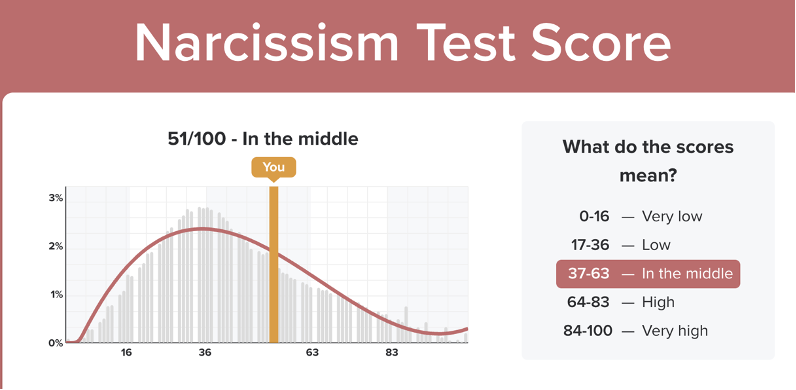
Phew. I didn’t score very high. But I did seem to have some narcissistic traits. Now for the interesting part. What’s going on in a narcissistic brain?
Your brain on narcissism
Simply put not much. In a review of over ten thousand articles on narcissism, fewer than a hundred addressed neurobiology. Here’s what we know. Narcissism tracks with higher testosterone, which is not terribly surprising given preponderance of male politicians, CEOs, and influencers. Next, people high in narcissism show heightened brain activity to social exclusion. They also show reduced activity in brain regions associated with empathy. In the last post, we learned that Parkinson’s disease causes a predictable single frequency oscillation in the brain. Are narcissists literally tuned into a different brain frequency than others?
Remarkably, the answer is yes—with a few caveats. A recent study recorded spontaneous brain activity using EEG in dozens of participants. Standard EEG uses 32 scalp electrodes, and each pairing (e.g., T3–O1) reflects the electrical activity between two sites. Here’s a sample of data output.
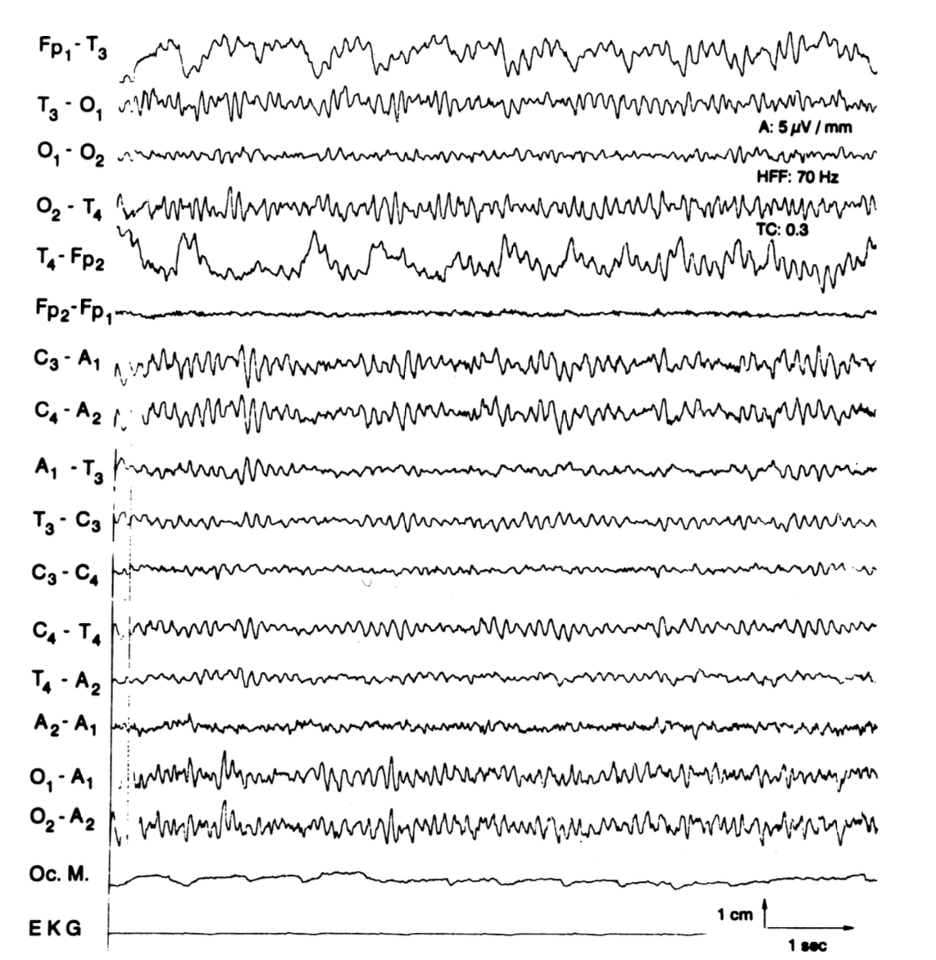
Source: De la Fuente et al., 1998, Figure 1.
Using signal decomposition, we can break down the brain patterns to see the relative contribution of each frequency. Before we look at the data, let’s ask a deeper question. Why should specific frequencies map onto behavior at all? Here’s a rough summary of the connection between brain frequency and behaviors.
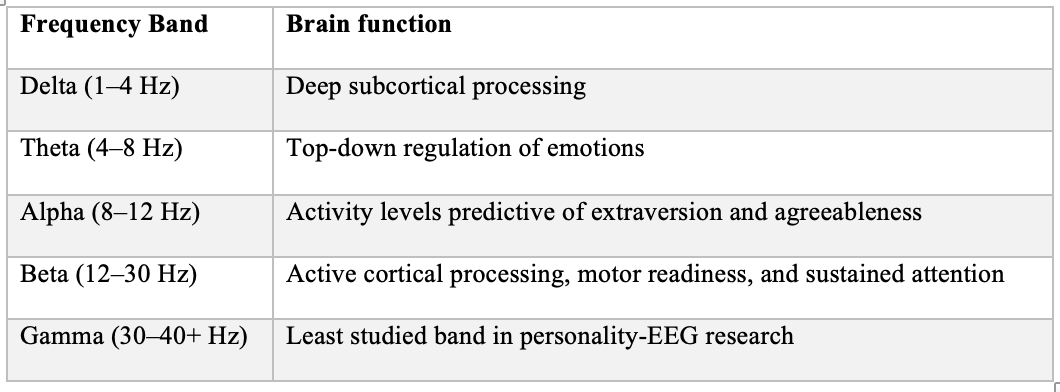
Compared to normal controls, narcissists brains hummed with different frequency patterns. They had lower theta power in distinct parts of their frontal lobe, suggesting less top-down control. Vulnerable narcissists showed less beta power, which could represent less cortical processing. Compare the ratio of delta to theta activity, and you can quantify coherence between bottom-up (integrating emotional information) and top-down processing (controlling emotions). Overall, the research suggests that different narcissism subtypes map onto distinct neural oscillatory “fingerprints.”
Hooking up electrodes and decomposing frequency patterns can only take us so far. To peer deeper into specific regions and circuits, researchers put subjects in an fMRI scans. By measuring ratio of oxygenated versus deoxygenated regions, they can estimate blood flow and infer neuronal activity. Which circuit? One stands out above the rest. The default mode network, or DMN for short, consists of a set of brain regions that combine to give us our sense of self.
The Default Mode Network (DMN) and narcissism
Most of your day involves coordinated activity across regions of the default mode network (DMN). It is especially active during mind-wandering, memory consolidation, and imagining the future. When your thoughts drift to a new job or planning a spring garden, you can thank your DMN. In narcissism, however, this system functions differently. Rather than supporting self-reflection, individuals tend to project power or insecurity outward. So how might the narcissistic DMN behave?
Simply measuring overall DMN activity is too crude. Instead, researchers examine how efficiently information flows between its nodes. Think of the DMN as a network of hospital departments: when a complex patient arrives, smooth coordination between the emergency department, cardiology, and the ward ensures coherent care. Strong interdepartmental connections reflect a high-integrity system. This property of local efficiency captures how well regions communicate and how resilient the system remains if one node fails.
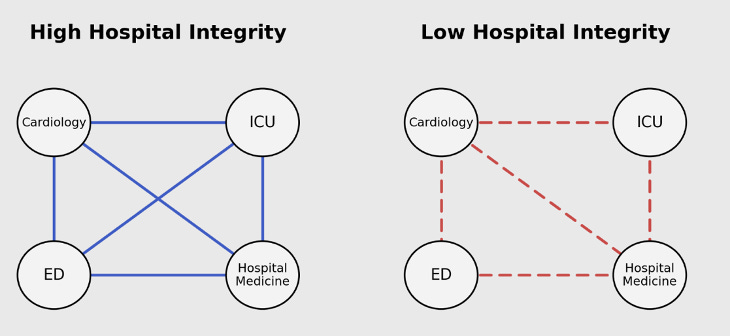
A similar level of coordination is required to sustain a coherent self. Within the DMN, interactions among regions integrate autobiographical memory, goals, and emotional states into a stable identity. These properties emerge from network dynamics, not any single region.
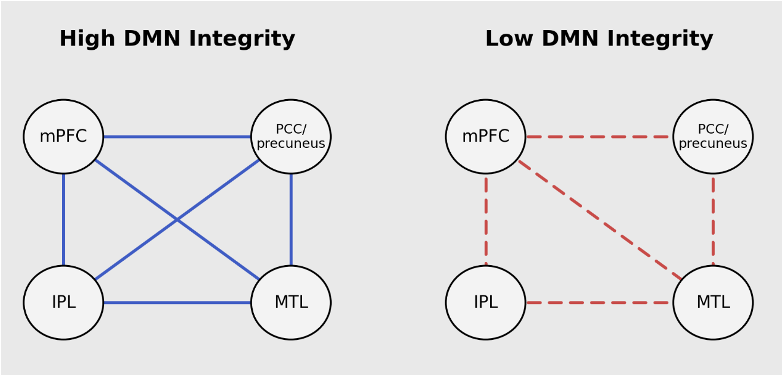
What happens in narcissism? Vulnerable narcissism combines entitlement with a fragile internal foundation. Here, local efficiency in the DMN is reduced. Connections weaken, and the network struggles to maintain a stable self-model—like a hospital whose departments have lost coordination and function as a disorganized whole. As efficiency declines, individuals are more likely to conceal aspects of themselves due to shame or fear of negative evaluation.
Clinically, this appears as a carefully curated exterior paired with anxiety about being exposed as inadequate. In contrast, grandiose narcissists show little such anxiety. Their inflated ego merges with identity, buffering against shame. In vulnerable narcissism, the most guarded individuals are often those with the most degraded self-referential networks—their DMN cannot sustain a coherent, stable self-representation.
Grandiose narcissism presents a paradox. While overall network efficiency remains impaired, the posterior cingulate cortex (PCC)—a key hub for self-referential processing and autobiographical integration—shows increased efficiency. The PCC becomes more central, with stronger connections to neighboring regions, as if compensating for broader dysfunction. This heightened hub activity may reflect excessive self-focus: an inflated yet unstable self-sustained by an overactive core within a fragmented network.
The DMN and its friends
Ask any teenager and they’ll tell you: you are who you hang out with. Same goes for the DMN. In a healthy brain, the DMN connects to reward circuits (thalamus and striatal), executive control regions (cortex), and emotional centers (amygdala). Like a highway that hasn’t been maintained in decades, in vulnerable narcissism, key connecting pathways lose structural integrity. Reduced connectivity to the amygdala impairs emotional integration. In grandiose narcissism, the core self-reward circuitry (fronto-striatal) may actually be deficient, leading narcissists to seek external sources of status and admiration to compensate for an inability to generate intrinsic self-reward.
What does it take to break a narcissistic circuit? Parkinson’s disease offers a useful model. There, brain circuits lock into rigid, predictable rhythms, while activities like tango, cycling, or music recruit alternative pathways, restoring a richer range of neural frequencies. The Jungian analyst Dr. Schwartz extends this idea to therapy: by strengthening self-reflection and observing our thought patterns, we can start to hum at different frequencies. Funding for Jungian analysands in fMRI scanners may be a ways off, but in the meantime, more radical approaches—meditation and psychedelics—suggest that the DMN itself can be reshaped.
Meditation, psychedelics and narcissism
Take experienced meditators. During meditation, connectivity dissolves between two “core-self” regions of the DMN. The same happens in psilocybin-assisted mindfulness. With psilocybin, the loss of connectivity between the two regions (mPFC and PCC) dissolves the ego. People feel boundaries between the self and world melt away. Before you book a psychedelic retreat for your loved ones with narcissistic tendencies, take caution. Since narcissism involves the degradation with the DMN, you risk destabilizing an already fragile sense of self.
The more promising approach for narcissism may be interventions that rebuild local DMN efficiency. Meditators experience a reduced identification with the narrative self (the “story of me”), and greater sensory awareness in the present moment. This is because the DMN befriends brain regions associated with top-down emotion regulation and attention. By shifting attention to the relationship between the ego and the self, people with narcissism can begin the lifelong journey to understand the self.
For people high on scores of vulnerable narcissism, meditation focused on self-compassion exercises seems to work better. This makes intuitive sense – for someone hypersensitive to judgment and an identity tied to others’, giving self-love can potentially rewire the DMN. For someone with more grandiose and exploitative tendencies, other-compassion exercises are more effective in increasing compassionate behavior. Like the Greek figure Narcissus, the grandiose individual may be too caught up in the ego to engage in compassion for the self. Instead, it may be easier to extend compassion to others than to oneself.
The way out
In popular culture, each season brings a different flavor of narcissism: covert, overt, malignant, toxic and even digital. One particular subtype, known as communal narcissism, has been shown to correlate with different brain frequencies. Instead of craving power, individuals high on the scale of communal narcissism view themselves as exceptionally caring, helpful and socially engaged. You can take the communal narcissism test here. After my intensive study on narcissism, it turns out I am a narcissist after all – just a communal one. Or maybe not. You can imagine humble leaders scoring high on this test as well. What truly distinguishes narcissism is not the zeal to change the world, but the motivation for recognition that comes with it. To dig deeper into one’s motivation requires more than a podcast, TikTok, or three-minute quiz.
Scientifically, you can think of narcissism as a pathological hum of certain brain frequencies or a fragmented neural circuit. But perhaps the same could be said for the dogged need to find pathology “out there.” I wasn’t watching “Nine Very Subtle Signs of Covert Narcissism” solely to become a better version of myself.
As the Jungian analyst Dr. Schwartz points out, the common denominator in all types of narcissism is not feeling safe enough to be known. You can see this in people who overidentify with titles and accolades. Their ego—reinforced by external achievement—merges with the self. The therapeutic work becomes examining the relationship between our inner selves and our ego. Another way to ask this is, “What is the pursuit of power, titles, and attention distracting us from?” For Narcissus to answer this, he would need to search for an internal self, underneath the veneer of beauty. His cautionary tale may teach us more than any neuroscientific finding. The work to create a world of sacrifice and compassion starts by looking within.
Selected references:
Chester, D. S., Lynam, D. R., Powell, D. K., & DeWall, C. N. (2016). Narcissism is associated with weakened frontostriatal connectivity: A DTI study. Social Cognitive and Affective Neuroscience, 11(7), 1036–1040. https://doi.org/10.1093/scan/nsw025
Cieri, F., Zhuang, X., Caldwell, J. Z. K., & Cordes, D. (2021). Brain entropy during aging through a free energy principle approach. Frontiers in Human Neuroscience, 15, 647513. https://doi.org/10.3389/fnhum.2021.647513
De la Fuente, J. M., Tugendhaft, P., & Mavroudakis, N. (1998). Electroencephalographic abnormalities in borderline personality disorder. Psychiatry Research, 77(2), 131–138. https://doi.org/10.1016/S0165-1781(97)00149-2
Dickinson, K. A., & Pincus, A. L. (2003). Interpersonal analysis of grandiose and vulnerable narcissism. Journal of Personality Disorders, 17(3), 188–207. https://doi.org/10.1521/pedi.17.3.188.22146
Freund, V. L., Peeters, F., Meesters, C., Geschwind, N., Lemmens, L. H. J. M., Bernstein, D. P., & Lobbestael, J. (2022). Narcissistic traits and compassion: Embracing oneself while devoiding others. Personality and Individual Differences, 185, 111271. https://doi.org/10.1016/j.paid.2021.111271
Miller, J. D., Lynam, D. R., Hyatt, C. S., & Campbell, W. K. (2017). Controversies in narcissism. Annual Review of Clinical Psychology, 13, 291–315. https://doi.org/10.1146/annurev-clinpsy-032816-045244
Zhou, Z., Huang, C., Robins, E. M., Angus, D. J., Sedikides, C., & Kelley, N. J. (2022). Decoding the narcissistic brain. Current Opinion in Psychology, 45, 101289. https://doi.org/10.1016/j.copsyc.2022.101289